1.7 Wedding Cake Model
The U.S. criminal justice system is a multifaceted institution, often examined through various models and perspectives. One model that provides insights into the differential treatment of cases within the criminal justice system is the “Wedding Cake Model.” Developed by Samuel Walker (2010), this model offers a framework for comprehending how cases are stratified and prioritized by both the media and society. It also sheds light on the complexities involved in criminal justice processing.
The Wedding Cake Model enhances our understanding of the functioning of the criminal justice system, and it underscores the influence of media attention on public perceptions of crime, the frequency of criminal incidents, and the overall operation of the criminal justice system. Walker (2010) classifies different types of cases into four distinct tiers based on their characteristics and implications. The size of each tier corresponds to the number of cases of that type handled by the criminal justice system. As illustrated in Figure 1.15 below, this model takes the general shape of a cylindrical pyramid that is divided into four separate tiers.
Figure 1.15
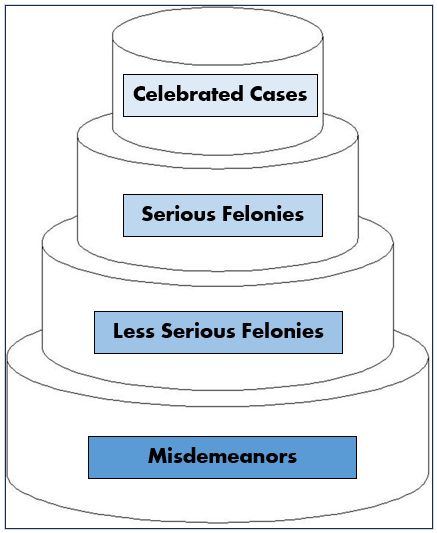
Celebrated Cases: In Walker’s model, the topmost layer is composed of a select few celebrated cases. These cases are characterized by being high-profile, headline-grabbing news stories that garner extensive national publicity and significant media coverage. Typically, these cases involve sensational crimes such as gruesome or very serious offenses, a large number of people, substantial amounts of money, or well-known individuals. Although these types of cases are rare, they receive the most attention and resources from the criminal justice system. As Walker (2010) notes, celebrated cases “usually involve the full criminal process, including that rare event, the criminal trial” (p. 40). News media outlets provide in-depth coverage of the trials of these high-profile cases, often emphasizing the unfolding drama. While this type of coverage serves as a form of public entertainment and boosts news outlet ratings, it consequently distorts the public’s perception of crime and criminal procedure. It is crucial to dispel the common misconception that most cases go to trial, as roughly 90% of criminal cases end in a guilty plea (Motivans, 2022). Furthermore, the vast majority of cases receive little to no publicity, despite the widespread misconceptions about the criminal process perpetuated by extensive news coverage of a single, highly publicized crime-based media event.
Serious Felonies: The subsequent tier encompasses serious felonies that may involve significant crimes like murder, sexual assault, armed robbery, or burglaries. While cases in this tier still undergo rigorous legal processes, they receive less attention and fewer resources compared to the celebrated cases in the top tier. Despite this tier consisting of only a small percentage of overall crimes, they are frequently reported in the local or state media, and we often hear about these types of crimes on a weekly or even daily basis.
Less Serious Felonies: The third tier comprises less serious felony offenses like drug crimes, property offenses, or certain white-collar violations. These offenses are often committed by young or first-time offenders or involve individuals who are acquainted or related. While still considered serious, these cases lack the sensational nature of the previous tiers and typically receive minimal to no attention from the media and the public. Generally, these cases undergo quicker criminal justice processing, including plea bargains, reduced charges, outright dismissal, or, most commonly, a probationary sentence. Despite these types of cases occurring more frequently than the previous two tiers combined, the lack of media coverage and public attention contributes to the distortion in the public’s perception of common crime types.
Misdemeanors: The final tier, forming the base of the Wedding Cake Model, consists of misdemeanors. This is the largest tier in the diagram as this type of crime constitutes the majority of criminal cases. This tier consists of misdemeanors, which are relatively minor offenses like petty theft, public intoxication, and traffic violations. These offenses typically result in less punitive punishments such as fines, probation, or short jail sentences. Despite the fact that cases in this tier make up the majority of all criminal cases, they receive the least attention from the media and the public, which further distorts the public’s perception of crime. Unlike cases in Layer I and Layer II, which demand due process, cases in this tier prioritize processing speed. The primary goal is to resolve these cases quickly through summary procedures, processing them en masse, reflecting the lower priority given to these cases by the criminal justice system.
The Wedding Cake Model highlights two significant issues. First, the extensive media coverage of high profile cases distorts perceptions of the likelihood of more serious and gruesome crimes. Layer I cases receive more continuous media attention through the investigation, arrest, trial, and appeals process, which can span several years. These cases are also frequently featured in podcasts, documentaries, television shows, and movies, repeatedly exposing the public to a single high-profile case while thousands of low-profile cases go unnoticed. Inconsistent media coverage of different crime types leads to the misconception that high-profile cases are common, distorting the public’s understanding of crime incidence in society.
Secondly, this model underscores the unequal treatment of cases within the criminal justice system. The processing and outcome of cases are influenced by various factors, including the type and severity of the crime, public interest, the offender’s criminal record, the relationship between the victim and offender, and available resources. Despite these disparities, there is a common misconception that most cases receive the same level of oversight and due process as high-profile cases. While not exhaustive, this model has played a crucial role in our comprehension of sentencing disparities and resource allocation in the criminal justice system.
Figure 1.16

Review Check