1.6 Criminal Justice Funnel
In his seminal work, “Two Models of the Criminal Process,” published in 1964, Herbert Packer characterized the criminal justice system as a continuous processing assembly line of endless criminal cases. This foundational conceptualization delineates the sequential stages and gradual attrition of cases within the criminal justice system, emphasizing the ways in which cases might be diverted at any stage of the process and thereby prevent them from reaching the end of the assembly line.
Figure 1.14
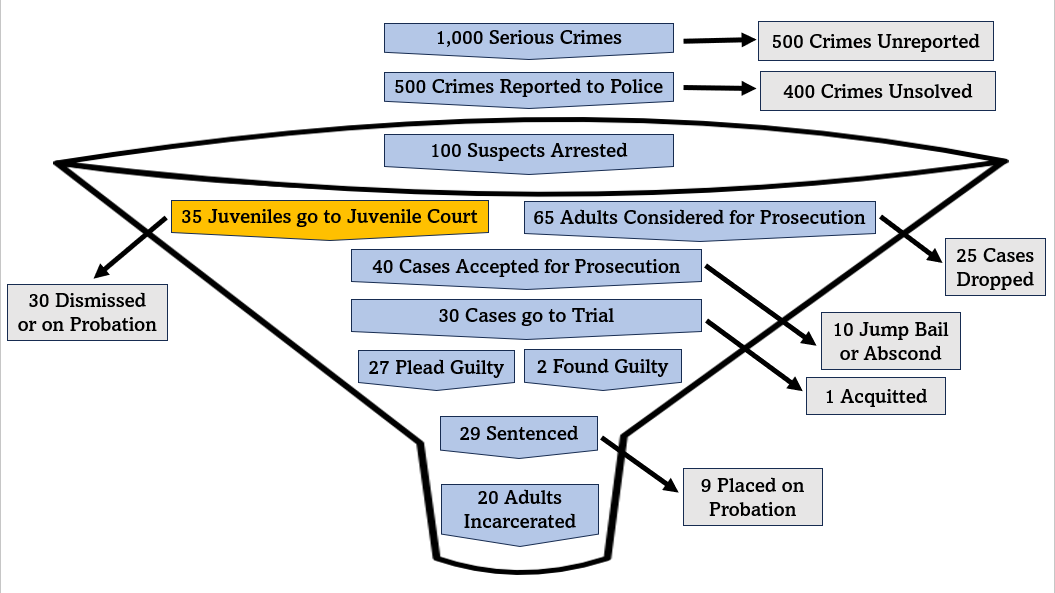
As depicted in Figure 1.14, for every 1,000 serious felonies committed, only half are ever reported to the police, with the remaining 500 serious felonies categorized as dark figures due to never being reported. Among the 500 reported felonies, only 100 arrests will be made as 400 cases remain unsolved. Out of these 100 arrests, 35 cases are diverted to the juvenile court, while the remaining 65 cases are sent to the prosecutor’s office to await consideration for prosecution. Among the 35 juvenile cases, 30 are either dismissed or placed on probation, and 5 juveniles are incarcerated. Regarding the 65 adult cases sent to the prosecutor’s office, 40 cases are accepted by the prosecutor and the other 25 are dropped. Out of the 40 prosecuted cases, 10 defendants either abscond or jump bail , leaving only 30 cases for the trial process. Among these, 27 cases end in a guilty plea, 2 result in a guilty verdict, and 1 concludes with an acquittal. Ultimately, for approximately every 1,000 serious felony crimes that transpire, only 20 adult offenders are incarcerated, and 9 are placed on probation.
Review Check