5.6 Theories of Victimology
Figure 5.9

In discussions involving victimization, it is important to determine if there are any possible relationships or causations that incorporated the acts and/or behaviors of the victim which may have led, intentionally or otherwise, to subsequent crime perpetration. This discussion does not intend to accuse or blame the victim. Instead, our analysis of possible roles may help us understand the lead-up to, and any possible encouragement or facilitation of, the crime(s) committed.
A theoretical construct may help us understand better the involvement, if any, of a victim prior to the criminal act. The construct is actually more of a continuum, indicating varying degrees of potential shared responsibility (Karmen, 2007). The range considers, on one extreme point on the continuum, a completely innocent victim (who has 0% shared responsibility) to the continuum’s opposite side, where victim fabrication (100% shared responsibility) resides. Of course, as with any continuum, there are intermediate levels of varying degrees of shared responsibility. In ascending order (least to most) of seriousness, we consider victim inaction, victim proneness, victim facilitation, victim precipitation, victim provocation, and finally, victim fabrication.
If one were to display the continuum for visual effect, with a short explanation for each, it might look something like this:
GREATEST LEVEL OF SHARED RESPONSIBILITY BY A VICTIM
Victim Fabrication: Originally believed to be a victim, facts ascertain they are fully 100% responsible for the crime(s) committed. In this case the victim has total complicity and full responsibility for the crime. For example, in an insurance fraud scheme, a false or embellished report of a collision might be made by a car owner, and verified by a co-conspirator who operates a repair facility. This would allow for the collection of money as reimbursement for unnecessary repairs, or repairs to damage that never happened.
Victim Provocation: The victim contributes in a highly substantial way to becoming a victim. An example of victim provocation can be seen in an altercation in a bar. Example: John insults Tom relentlessly. When Tom tries to ignore his tormentor, John picks a fight with Tom. Tom is fed up with the teasing and responds by killing John.
Victim Precipitation: Victims can be instigators of a crime and thereby be considered as partially responsible for the crime when it happens if their actions significantly contributed to it. An example of such an instigation might be challenging verbal (calling someone a derogatory name) or displaying a hostile gesture, or cutting another driver off in traffic, precipitating an act of road rage.
Victim Facilitation: In this case, victims may unknowingly make it easier for a crime to occur, through careless behavior, negligence, or foolishness. For example, parking your vehicle in an area accessible to the public, then leaving your doors unlocked, a window partially down, and keys in the ignition would be an example of how the victim made a crime easier to commit by someone.
Victim Proneness: A person who operates in dangerous environments, lives in high-crime areas, or socializes with known criminals increases the potential for becoming a victim.
Completely Innocent: Someone who in no way contributes consciously nor participates in an event which victimized them, would be considered completely innocent. For example, Imagine someone visiting a bank to transact business who gets caught up in an armed robbery. If ordered to lie prone on the floor, not pull an alarm or call the police, and willingly capitulates to the demands of the robber, should not be faulted for their inaction under duress.
LOWEST LEVEL OF SHARED RESPONSIBILITY BY A VICTIM
It should be understood that a victim might fall into any one, or a combination of two or more, of the above listed levels of shared responsibility, depending upon circumstances related to the event (Karmen, 2007).
Routine Activity Theory
The Routine Activity Theory (RAT), developed by Cohen and Felson (1979) is a victimization theory. Though we covered it in the last chapter, it is important to remember, that this is a theory commonly tested by victimologists. To read a little more about RAT, or to refresh your memory, read this excerpt from 5.5. Neoclassical by Brian Ferdorek [1]
Cohen and Felson (1979) claimed changes in the modern world have provided more opportunities for offenders. [2] Since the conclusion of World War II, more people have entered the workforce, and more people spend time away from home. Cohen and Felson stated that three things must converge in time in space for a crime to be committed – a motivated offender, a suitable target, and the absence of a capable guardian.
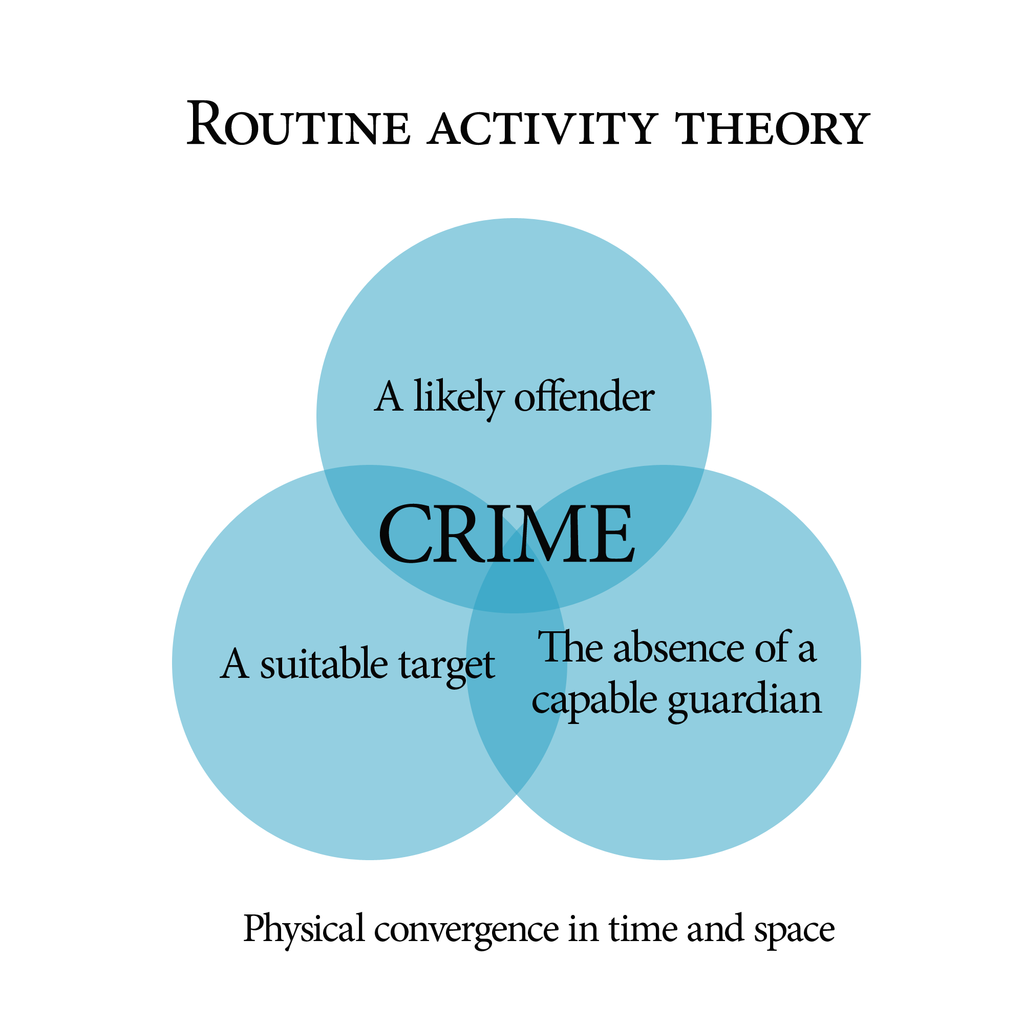
The motivated offender is considered to be a given as there will always be people who will seize opportunities to commit criminal offenses. Besides, there are a variety of theories to explain why people commit a crime. Suitable targets can be vacant houses, parked cars, a person, or any item. In reality, almost anything can be a suitable target. Finally, the absence of a capable guardian facilitates the criminal event. What can serve as a “capable” guardian? A plethora of people and things can serve as guardians. For example, police officers, security guards, a dog, being at home, increased lighting to allow other people to see, CCTV, alarm systems, and deadbolt locks can each reduce opportunities by serving as a capable guardian. Routine activity theory concentrates on the criminal event instead of the criminal offender.
Review Checks