12.17 Current Issues: Terrorism in America
Brandon Hamann
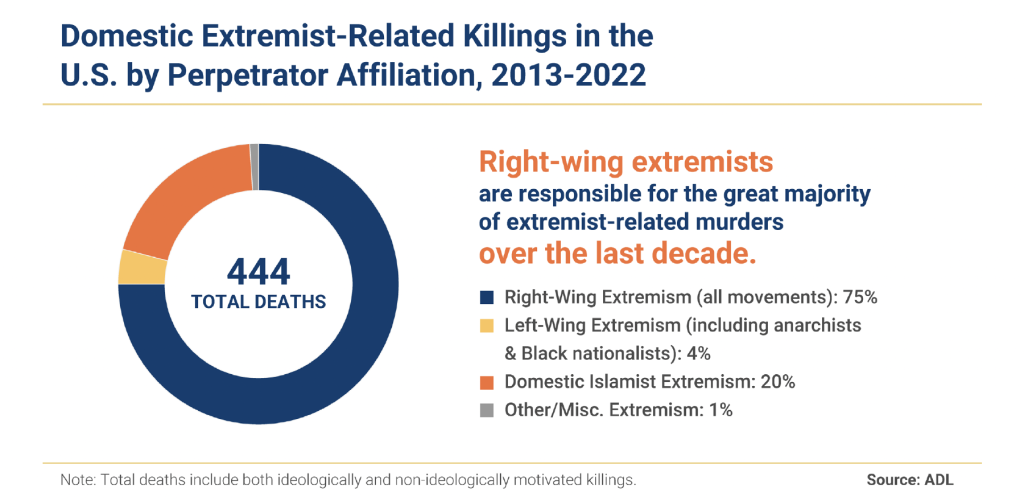
Contrary to popular belief, terrorism in the United States did not begin with the catastrophic events of September 11, 2001. Needless to say, the downing of the World Trade Center Towers in New York City will be forever ingrained in the memories of Americans forever. However, there have been many events that foreshadowed this one incident that were just as memorable, if not more so. Before we get into further detail, it is important that we give a bit of context into the history of Terrorism and its impact on current issues within the Criminal Justice System in the United States, because the United States has had such a unique relationship with the term “terrorism.” And what the graphic below shows is that not all acts of terrorism come from foreign adversaries. Much of it is born right here inside the United States.
12.17.1. What is Terrorism?
“Terrorism” is an extremely difficult word to define. It really depends on which side of the argument you are on in how you would describe its meaning. Have you ever heard the phrase “one person’s trash is another person’s treasure?” When discussing terrorism, the phrase can be reinterpreted as “one person’s freedom fighter is another person’s terrorist.” For example:
Star Wars

A small group of rebels have banded together in an alliance to fight back against the tyranny of the Galactic Emperor and his powerful Sith Lord Vader to rid the galaxy of their evil and win freedom for their friends and families and bring peace and democracy to the people.
- If you’re a supporter of the Rebels, you see them as Freedom Fighters, fighting against the Evil Empire.
- If you’re a supporter of the Empire, you see the Rebels as Terrorists, usurpers trying to change your comfortable way of life.
This is an oversimplification of an age-old story plot. However, when discussing terrorism, it can get much more complex.
For the purposes of this Introductory text, a generalized definition of terrorism is the best course. Therefore, terrorism is the unlawful use of violence and intimidation, especially against civilians, in the pursuit of political gains.
12.17.2. A Brief History of Terrorism in America
If we were to have a serious global historical discussion about terrorism, this textbook would be very long. In fact, there are entire courses dedicated to the study of Terrorism and Counterterrorism at the college level if you choose to pursue a career in that field. We would have to go back to before the creation of the United States to even before the journey of Christopher Columbus. However, we will keep the historical context in America to the 20th century until the present.
12.17.2.1. The Milwaukee Police Department Bombing (1917)
Italian anarchists protesting against the conscription of men into World War I unintentionally detonated an improvised explosive device inside the Milwaukee, Wisconsin Police Department, killing 9. The bomb was meant to be set off inside a nearby church, where a local priest was campaigning for the war effort (Esmail, Eargle, and Hamann, 2021).
12.17.2.2. The Tulsa Race Riots (1921)
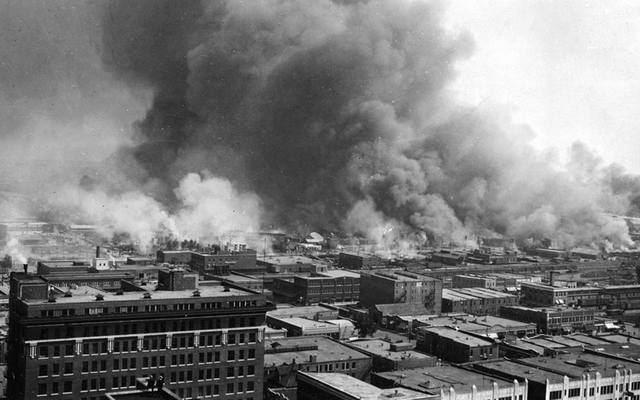
Greenwood, Oklahoma, a suburb of Tulsa, is burned to the ground when an angry mob of white residents descend upon the majority black community after a black man is accused of assaulting a white woman. The area at the time was known as “Black Wall Street” because of the affluence of the black-owned businesses that made up the neighborhood (Esmail, Eargle, and Hamann, 2021).
12.17.2.3. The Unabomber (1978-1995)


Theodore “Ted” Kaczynski, a noted Harvard educated mathematician and engineer, terrorized the country by sending homemade letter bombs through the mail. It was only after family members recognized his writing style from a manifesto Kaczynski had sent to media outlets that he was apprehended in a small log cabin in rural Montana. Ted Kaczynski took his own life while in prison in June 2023 (Esmail, Eargle, and Hamann, 2021).
12.17.2.4. World Trade Center Bombing (1993)
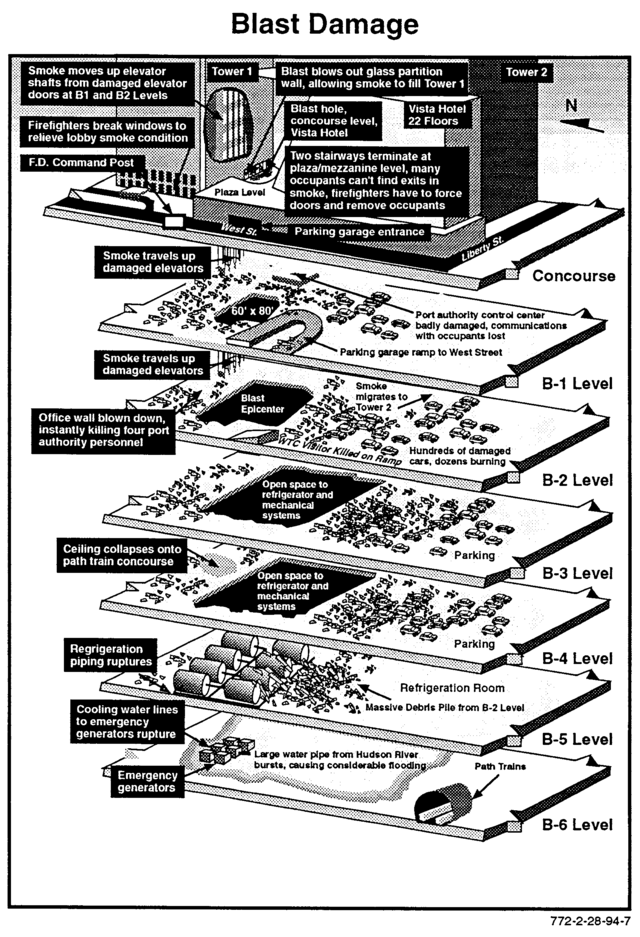
Believe it or not, the events of September 11 were not the first time the World Trade Center Towers were the victim of a terrorist attack. In the early morning of February 26, 1993, a moving van loaded with a chemical mixture of fuel and fertilizer was detonated in the parking garage of the North Tower. Six were killed, and over 1000 people were injured in the blast. Ramzi Yousef, a member of an international terrorist group called al-Qaeda, was tried and convicted with 5 other co-conspirators (Law, 2016).
12.17.2.5. The Branch Davidians (1993)
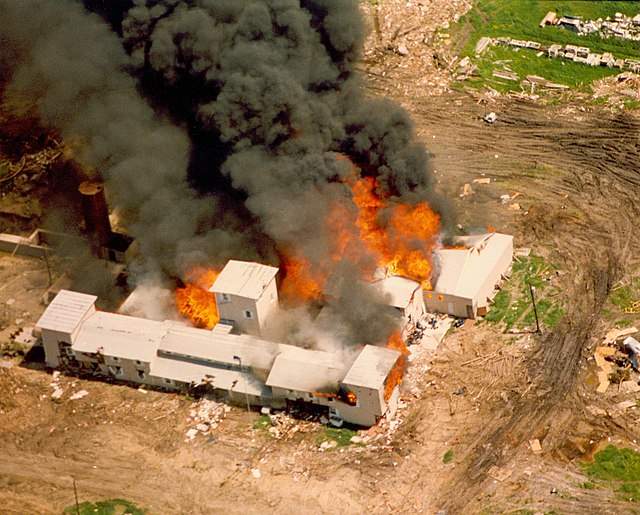
Fearing that a group of Christian Fundamentalists called The Branch Davidians were stockpiling illegal weapons and maintaining a meth lab inside their Waco, Texas compound, the ATF and DEA attempted to execute a search warrant on February 28, 1993. Fifty-one days later, 82 members of the Branch Davidian group, including men, women, and children, and multiple federal law enforcement officers, had been killed during a lengthy standoff that ended in a fire that consumed the building where the leader, David Koresh, had been hiding out.
12.17.2.6. The Oklahoma City Bombing (1995)
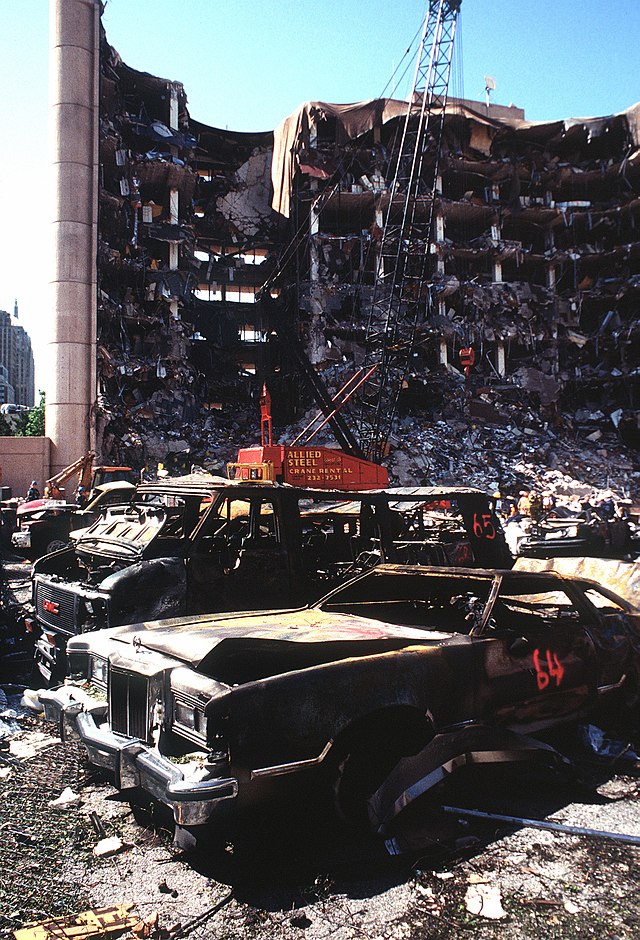
In retaliation for the disaster at Waco, among others, two American extremists, Timothy McVeigh and Terry Nichols, detonated an improvised explosive device in front of the FBI building in Oklahoma City, Oklahoma, on April 19, 1995. The explosion killed 168, including children who were attending childcare services for federal employees working in the office building.
12.17.2.7. Atlanta Olympics Bombing (1996)
During the 1996 Summer Olympics in Atlanta, Georgia, a pipe bomb exploded in Olympic Park, killing 2 and injuring 111. Initially, the FBI had alleged the perpetrator to be a security guard, Richard Jewell, and made every attempt to discredit him in an attempt to get him to confess. Jewell was later exonerated when, in 2003, Eric Rudolph was arrested after a lengthy manhunt for the bombing of an abortion clinic in Alabama, Atlanta, and the bombing of a gay nightclub.
12.17.2.8. World Trade Center Towers (September 11, 2001)
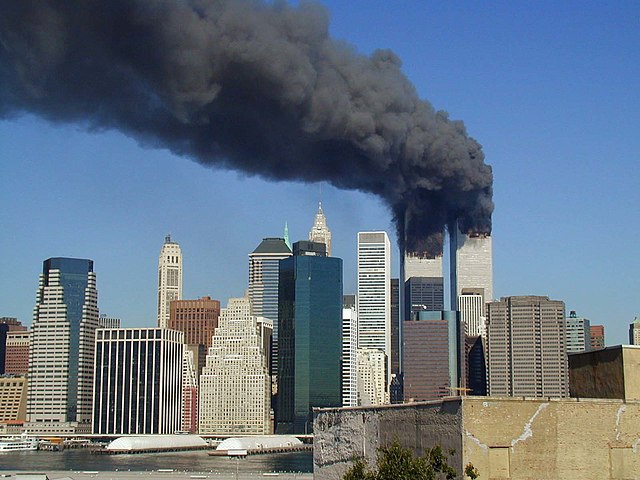
After failing in 1993 to take down the World Trade Center Towers from the inside, al-Qaeda leader Osama bin Laden orchestrated a daring plot to topple the buildings from the sky. Two commercial airliners were hijacked and flown directly into Towers 1 and 2, culminating in their collapse on September 11, 2001. Additionally, a simultaneous attack was carried out against the Pentagon in Washington, D.C., when another hijacked commercial airliner was flown into it. A fourth attempt was thwarted when passengers were able to successfully subdue the terrorists and force the plane down in a field in rural Pennsylvania. Reports indicated that flight was intended for either the White House or the Capitol Building.
12.17.3. Domestic Terrorism
While the events of 9/11 awakened the United States to the threat of foreign terrorist attacks, there was still the issue of how the country and its criminal justice system defined domestic threats as well. Even while the country fought to avenge the destruction of the World Trade Centers on a global scale, it was wrestling with how to deal with its own homegrown problems. Terrorism in its simplistic definition does involve violence for political gain; that violence gets even more complex when other ideologies become involved, such as
- Religion
- Homophobia
- Xenophobia
- Racism
- Environmental Extremism
Since 9/11, there have been some notable domestic events that have added to the debate of just how far behind the criminal justice system is in dealing with terroristic attacks on U.S. soil by U.S. citizens. In 2015, Congress attempted to fix that by passing The Freedom Act and 18 U.S. Code 2331, both of which were instrumental in defining what domestic terrorism was (Hamann, et al., 2021). Unfortunately, neither legislation laid out the groundwork for penalties to be sanctioned on those who were convicted of crimes of domestic terrorism.
In order to fight global terrorism, the United States government began a counterterrorism campaign that included a war effort against al-Qaeda and the countries alleged to have given them financial support and shelter. This brought the United States into conflict with Afghanistan and Iraq. Ultimately, these campaigns led to the deaths of both the leaders of al-Qaeda, Osama bin Laden and Saddam Hussein, the militant dictator of Iraq. However, by the end of 2017, those war efforts had cost the United States approximately $2.8 trillion dollars (stimson.org).
Domestically, since 9/11, the United States has continuously increased its spending on counterterrorism efforts domestically. President George W. Bush created the Department of Homeland Security in 2002 with the expressed purpose of safeguarding the American people from domestic threats. These threats include cyber attacks, border security, and domestic terrorism in cooperation with the FBI. The Department of Justice has also been given ample budgetary monies to investigate and prosecute domestic offenders. In 2022, the Department of Justice (DOJ) budget request totaled $101.2 million for domestic terrorism threats alone. This allocation would be used for the FBI, U.S. Marshals, U.S. Attorneys, and other offices to research “domestic radicalization” (DOJ, 2022).
Preventing Domestic Violent Extremism: Insights from RAND Research
Review Checks
Media Attributions
- Domestic Extremist-Related Killings in the U.S. by Perpetrator Affiliation, 2012-2022
- Star_wars2.svg
- TulsaRaceRiot-1921
- Unabomber_-_FBI_Sketch_1987
- Unabomber
- FEMA_TR-076_-_1993_World_Trade_Center_Bombing_-_Report_and_Analysis_-_Blast_Damage
- 640px-Branch_Davidian_Compound_in_Flames
- 640px-Oklahomacitybombing-DF-ST-98-01356
- OLYMPUS DIGITAL CAMERA